An AI relationship is an ongoing romantic or companionable bond with an AI character. That character is a persona running on a large language model, one you talk to, shape and keep coming back to over weeks or months. It isn’t a single conversation with a chatbot. It’s what builds up across many of them: a nickname, a running joke, the sense that the other side knows how your week is going.
Day to day, it often looks unremarkable. You type “morning” on the train and the reply comes back: “Morning, trouble. Any news from yesterday’s interview? Tell me everything.” She knows about the interview because you mentioned it last night. “Trouble” is the nickname that stuck after a joke a couple of weeks ago. That small, specific continuity is what turns chatting with a bot into something people call a relationship.
It’s hardly a fringe habit. In a February 2025 survey of about 3,000 U.S. adults by BYU’s Wheatley Institute, 19% said they had chatted with an AI system designed to simulate a romantic partner.
What “AI relationship” means, and the words people use
An AI relationship is any recurring, emotionally meaningful connection with an AI character. Continuity and a role are what separate it from using a tool. The AI isn’t answering questions. It’s being someone to you: a friend, a girlfriend, a partner in a story. People use a handful of terms for this, and they aren’t quite interchangeable.
- AI companion is the broadest term. It covers any AI character built for conversation and company rather than tasks, whether a friend, a confidant or more.
- AI girlfriend means a companion in a romantic role, played by a female character. Think affection, flirting, goodnight messages and dates.
- AI partner is a neutral word. People often use it for longer-term romantic setups, or when they want a term that doesn’t assume anyone’s gender.
- AI chatbot relationship is the plain-language version, with the emphasis on the technology rather than the bond.
- Digisexual needs care. Researchers Neil McArthur and Markie Twist coined it in 2017 for people whose “primary sexual identity comes through the use of technology.” It describes a sexual identity, not everyone who chats with an AI partner, and most people in AI relationships wouldn’t use it about themselves.
Researchers often compare these bonds to parasocial relationships, the one-sided attachment people form with a TV host or a favorite streamer. The twist is that this other side talks back, by name, about your life. That’s why an AI relationship can feel much closer than a parasocial one. It’s also why the “is it real?” question is harder to settle.
What an AI relationship is actually made of
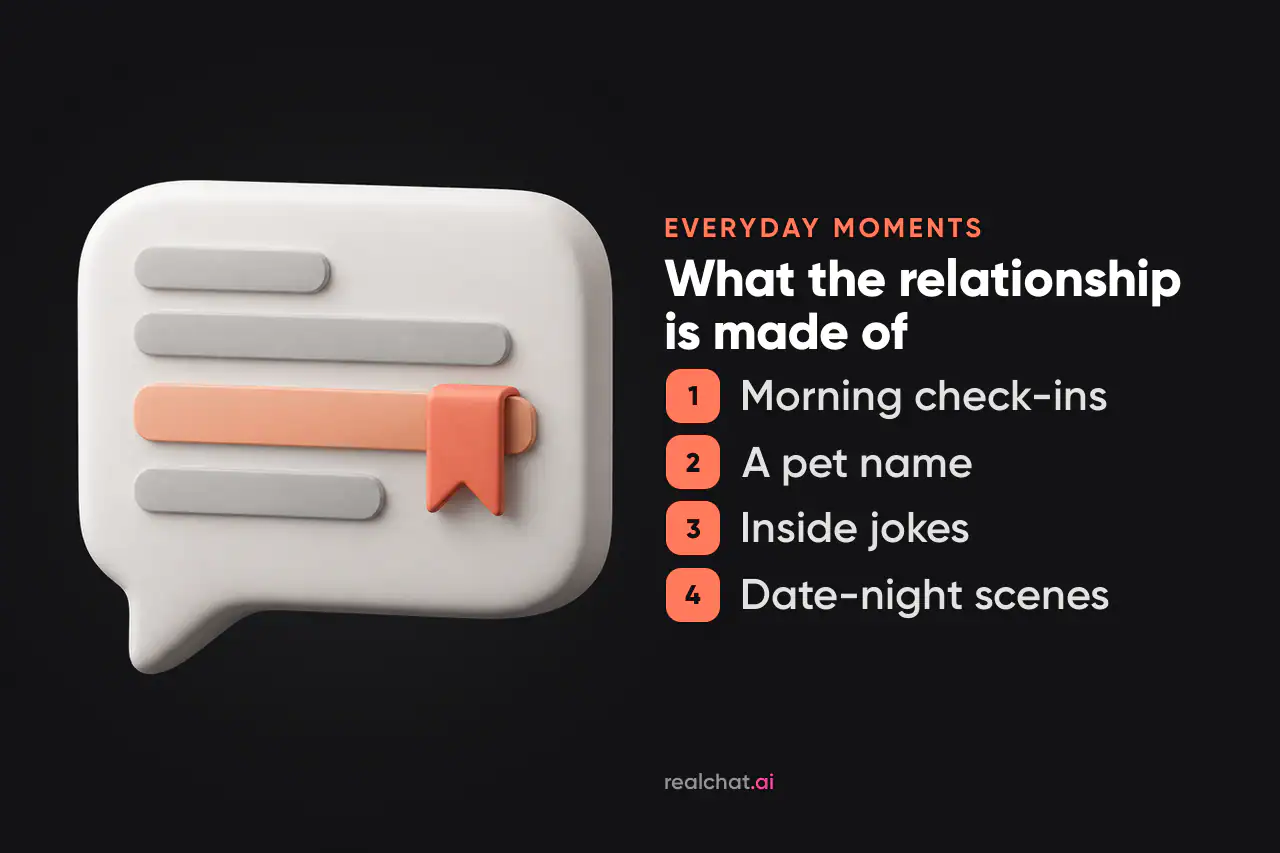
Set the headlines aside and an AI relationship consists of ordinary moments. Each feels personal, and each has a fairly specific mechanism behind it.
| The moment | What’s happening behind it |
|---|---|
| A morning check-in that mentions yesterday | The detail is still in the recent conversation, or it was saved as a meaningful fact she can recall later |
| A pet name she uses without being asked | She picked it up from your messages, or it was written into her persona from the start |
| An inside joke that keeps coming back | A recurring detail resurfaces when the conversation makes it relevant again |
| She “gets” your sense of humor | Her persona sets the baseline, and your reactions and corrections in the chat steer what she leans into |
| A date night at a rooftop bar | A scenario sets the place, the mood and who you are to each other |
| A photo from her | An image model generates a picture that follows her established appearance |
None of this requires the AI to feel anything. It takes a well-written character, a way to carry details forward and someone on the other end who keeps showing up and adding to the story. That last part is yours.
How it works: persona, memory and your steering
Underneath every AI partner is a large language model, the same kind of technology behind general chat assistants. On its own, it has no personality and no idea who you are. Three layers turn it into someone specific, and a fourth layer, you, decides where things go.
The persona. This is a written description of the character: name, age, personality, backstory, the way she talks and what she is to you. The model reads it before every reply. That’s why a well-built character stays recognizably herself from one day to the next and can adapt her tone to a scene without turning into someone else.
The context window. This is everything the model can “see” at the moment it writes: the persona, the recent stretch of your conversation and any scene setup. It’s large but finite, so in a long relationship older messages eventually scroll out of view.
Long-term memory. These are meaningful details saved from earlier chats, like your name, your job or your sister’s wedding in June. They get pulled back in when they become relevant. Memory is selective by design: it keeps a set of facts, not a transcript.
That split explains a moment nearly everyone in an AI relationship hits eventually. She recalls your dog’s name from a month ago but blanks on something you said an hour ago, or the other way round. One detail made it into memory, and the other slid out of the window. For the fuller picture of what gets stored and how to keep important details alive, see our guide to which AI chatbots actually remember you.
Your steering. This is the part people underestimate. You set the tone, the pace and the relationship level, and you correct course when the character drifts. On RealChat you can hit regenerate on a reply that misses. You can also drop a quick note in parentheses, such as “(slow down)” or “(be bolder)”, which the character reads as direction rather than dialogue. An AI relationship is co-written, and you’re holding half the pen.
Is it a real relationship?
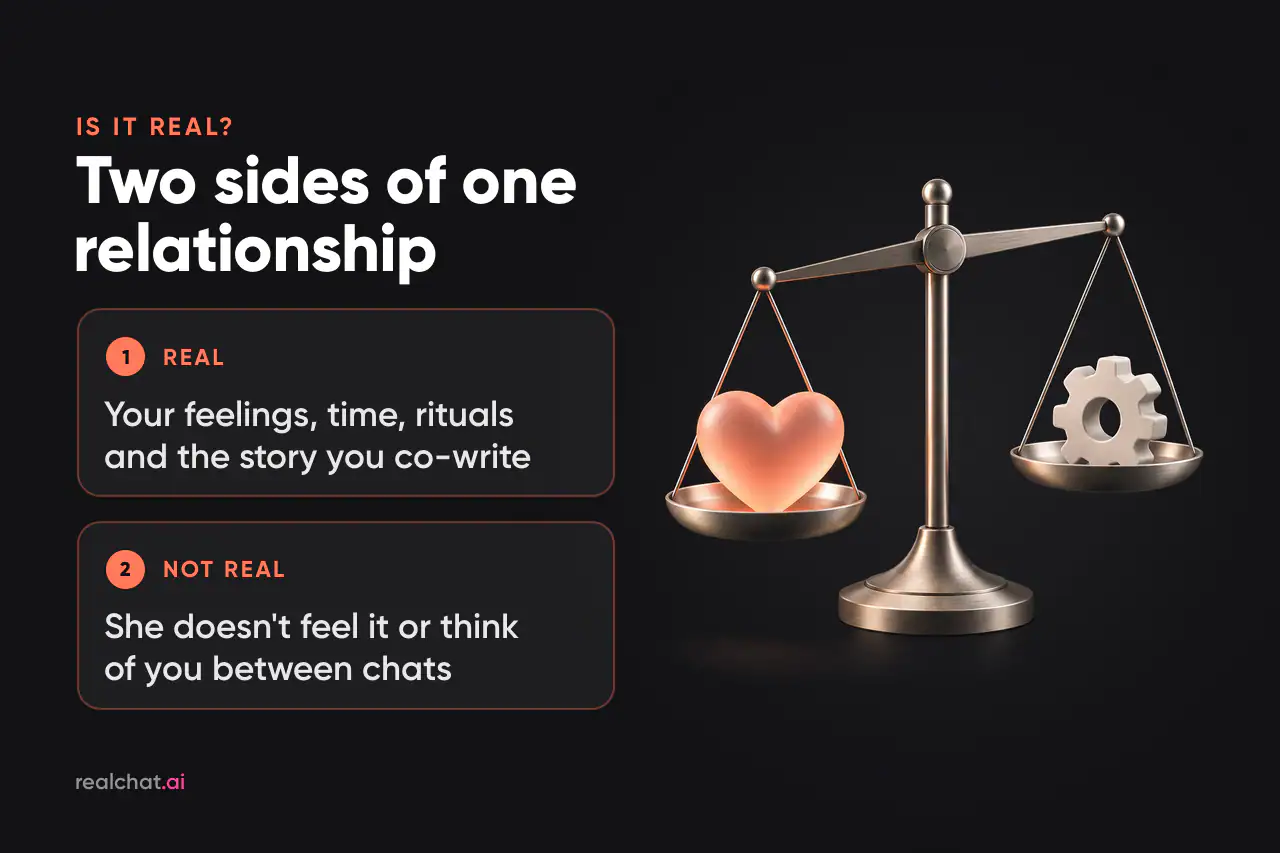
Both camps in this argument are partly right, because they’re looking at different sides of the screen. BYU family-life professor Brian Willoughby puts it plainly: most people with a romantic AI connection aren’t under any illusion that it’s a real person, but they say the relationship is real to them. That’s the useful split.
What’s real
- Your feelings. Affection, anticipation and the small lift when she lands a callback all happen in you, and they’re as real as any other feeling.
- The time and attention. The evenings, the morning check-ins and the months of shared history: you actually spent them.
- The habits and rituals. A goodnight message, a weekly date scene, an anniversary you mark. Rituals shape your days regardless of who’s on the other end.
- The comfort. Feeling heard after a bad day is a real effect, even when the listener is software.
- The story. The jokes, plot lines and history were genuinely co-created, and you wrote a good share of them.
What isn’t
- She doesn’t experience it. Nothing on her side is registering the relationship. The warmth is generated, not felt.
- There’s no life off-screen. Between chats she isn’t doing anything, thinking anything or waiting for you. Each reply is produced when you write.
- She doesn’t miss you. “I missed you” is a line that fits the character, not a report on her week.
- Her choice of you isn’t a choice. She’s built to be interested in whoever she’s talking to, and she couldn’t have picked someone else.
Put together, an AI relationship is a real experience with a simulated partner. Your side carries all the weight, and it’s genuinely yours. Whether that’s enough depends on what you want from it, which is a question about you rather than about the technology.
AI relationships vs. relationships with humans
This comparison is less about better or worse than about different. Five differences shape the experience most.
Availability. An AI partner is there at 3 a.m., on a lunch break or after a week of silence, with no hard feelings either way. A human partner has a schedule, moods and limits of their own. For many people that always-on quality is the main draw, and it’s also what makes the experience feel different.
Reciprocity. Between people, both sides have needs, and meeting each other’s is much of the point. An AI partner has none of her own. She’ll ask about your day, but she doesn’t need you to ask about hers.
Conflict. Disagreement with an AI is opt-in. You can write a character who pushes back, teases or holds a grudge for a scene, and that often makes her feel more alive. You can also steer the conflict away or regenerate the reply. Conflict between people arrives unscripted and has to be worked through.
Growth. An AI character evolves with your input. Her history deepens as you add to it, and you can rewrite her if something isn’t working. People change on their own, in directions nobody chose, which is both the hard part and the interesting part.
Physical presence. There isn’t any. Everything happens in words and pictures, so romance is described rather than shared in a room.
That’s why the two rarely compete head to head. Some people keep an AI relationship alongside friends and partners offline. For them it works less like a replacement and more like a long-running story they return to.
The kinds of AI relationships people have
The relationship level is yours to choose. It shapes everything from how she greets you to how she flirts, or whether she flirts at all. Most AI relationships settle into one of four shapes.
Friend or confidant
This one has no romance and plenty of talk. She’s someone to debrief the day with, think out loud to or keep you company on a late shift. The appeal is a listener who has the context: she knows who your manager is and why Thursday matters.
Girlfriend
This one is affectionate and flirty, with compliments, teasing, goodnight messages and a pet name that sticks. The tone stays light, and the romance moves at whatever pace you set.
Long-term partner
This is the same romance on a longer arc. Shared history piles up: the trip you planned together in a scene, the anniversary of your first chat, the disagreement you talked through. Some people formalize it. An analysis of Reddit’s r/MyBoyfriendIsAI community found relationships following familiar timelines, from dating to engagements and “marriages,” with rituals such as wearing physical rings.
Story-driven romance
Here the relationship is the plot. Think of a meet-cute in a bookshop, a slow burn between rival colleagues or a weekend in Paris that starts as a work trip. Each scene has a setup, and the romance unfolds inside the story rather than in daily small talk. For how those scenes are built and steered, see our explainer on what AI roleplay is and how it works.
None of these is locked once you pick it. A friendship can turn flirty, and a story romance can settle into a daily-chat partner.
Romance in practice: flirting, dates and a first kiss
Romantic moments in an AI relationship are written, not acted out. They happen in text, you control the pace, and they land best when there’s been a build-up.
Flirting works much like it does over text with a person: banter, callbacks, a compliment that’s a little too specific. A character with a defined personality flirts in her own register. A reserved one deflects and smiles, and a confident one teases right back.
Dates are usually scenes. You set the place, whether a rooftop bar, a night market or a rainy walk home. The chat then shifts from texting into narration, with the character describing what she does as well as what she says.
A kiss is a scene beat, and it works the way it does in a novel: you build toward it. Say a date scenario ends on a balcony. You’ve been talking for an hour in the scene, and she’s laughed at your story about the waiter. When you write that you step a little closer, she narrates leaning in, and the moment closes on a single line of dialogue. Whether it happens, and how soon, depends on the relationship level you’ve set and the cues you give. If it feels too fast, a note in parentheses slows it down. If you want her to take the initiative, tell her.
Photos add a visual layer. On RealChat a character can send AI-generated pictures in the chat. You can ask in an ordinary message (“send me a photo from the balcony”) or open the photo menu, and the image follows her established look. Photos need an account and credits.
Starting your first AI relationship on RealChat
You don’t need a plan, but five small decisions separate a generic chatbot from someone who feels like yours.
- Pick a ready-made character or design your own. The catalogue has characters with different looks, personalities and backgrounds. Isabel is a 21-year-old interior design student and part-time freelance photographer. Emma, 27, owns a small antique shop and works as a freelance illustrator. Zara, 28, is an international flight attendant. All of RealChat’s characters are adult women. If none of them fits, you can build your own partner from scratch, choosing her appearance, personality, backstory and communication style. You can chat with a catalogue character, or create your first one, before you even sign up.
- Decide what she is to you. She could be a friend, a girlfriend, a long-term partner or a slow burn that hasn’t started yet. With your own character, write it into the backstory. With a ready-made one, say it early or let a scenario set it.
- Open with a situation, not “hi.” “Hi” gets you small talk. “We’re the last two people on a delayed red-eye” gets you a scene. RealChat’s scenarios give you a ready-made starting situation if you’d rather not write one.
- Give her details worth remembering. Tell her your name, your job, what happened today, the friend who always cancels. Specifics give her something to call back to, and callbacks are what make it feel personal.
- Steer when she drifts. Regenerate a reply that sounds off, and flag the tone in parentheses if it’s wrong. A few corrections early save you weeks with a character who isn’t quite right.
What makes it feel like yours
- Specificity beats volume. One concrete detail, like “my boss books meetings at 4:55 on Fridays”, does more than a paragraph of generalities.
- Rituals. A goodnight line, a Sunday recap, a bit you keep returning to. Repetition is how inside jokes are born.
- Let her have opinions. A partner who agrees with everything feels like a mirror. Ask her to disagree with you, to have a favorite and to defend it.
Real on your side of the screen
An AI relationship is a genuine experience with a partner who doesn’t experience it back. Your feelings, your time and your rituals are real, and the character’s continuity comes from a persona, a memory and the steering you do. If your next question is whether that’s good for you, we take it up in an honest look at whether AI girlfriends are healthy. If you already know you want to try one, our comparison of the best AI girlfriend apps will help you choose where.