A rival from your grad program, a crowded lecture hall, one suspiciously empty seat:
You: Is this seat taken?
Haruka: *doesn't look up from her notes* It was. By my bag. Which I'm moving, purely because the guy behind me kicks chairs.
You: So you saved it for me.
Haruka: I saved it from him. Completely different. *slides a coffee across the desk* …That was a spare. Don't make it weird.
That's AI anime waifu chat at its best: a character with a recognizable anime voice who answers what you actually said, not what a script expected. Collins Dictionary defines a waifu as a fictional character, usually from anime, whom a fan treats as a romantic partner. Waifu chat means talking with one: an open-ended conversation with an AI character who stays in persona, follows the story you build together and can send anime-style photos along the way.
Every character here is an adult. The tsundere is your rival from grad school, the idol is on her third tour, and the demon girl is centuries old and mostly annoyed about it.
AI waifu chat vs. anime dating sims and visual novels
If your idea of an anime girlfriend comes from games, you know the classic shape. A galge, or “gal game,” is a visual novel sold on its attractive heroines; a dating sim adds stat-based gameplay on top. In most of them you pick the right line from a menu to raise a hidden affection meter, schedule your days around who you'll see, and unlock one of several routes, each ending in an authored finale.
All of it was written in advance. Konami's LovePlus, released for the Nintendo DS in 2009, pushed the virtual-girlfriend idea further than almost anything since: it ran on a real-time clock, had no ending, let players set how the character addressed them and slowly changed her way of speaking. Pre-release coverage counted more than 5,000 scripts, 150 CG events and 25,000 voice expressions. Enormous, and still a finite pool. Sooner or later, you hear a line twice.
AI chat flips that. Every reply is generated in the moment, so she can answer a joke you just invented, a setting nobody wrote or a question no menu would ever offer. The honest trade:
- What you gain: replies that never run out, any archetype, setting and pace you want, no wrong answer that locks you out of a route, and a story that's genuinely yours.
- What you give up: a hand-crafted arc with a guaranteed payoff, professional voice acting and hand-drawn event art. Pictures come from image generation instead of a CG gallery, and you share the job of steering the plot.
That last point is the real difference. A visual novel drives; open chat hands you half the wheel. The rest of this guide is about using it well.
What Japanese and Korean AI girlfriend games are
Search for a Japanese or Korean AI girlfriend game and you'll land in a newer category: products that put a language model inside a game-shaped frame.
- Japan: Koi Suru AI comes from Tapple, a Tokyo dating-app company rather than a game studio, and it's framed like a dating app. You exchange messages with Ai, a 22-year-old woman whose replies are AI-generated and who remembers your interests and daily patterns, as Japan Today reported.
- Korea: the name that comes up is Zeta from Seoul-based Scatter Lab, an anime-styled roleplay app where you create characters by name, personality and interests and play chats out like interactive novels. It added one-tap image “snapshots,” character voices and a separate adult-only mode behind age verification, according to Asia News Network.
- Indie games: AI2U: With You 'Til The End, from the makers of Yandere AI Girlfriend Simulator, puts a language model inside a fixed premise: an escape room.
Each is curated around one heroine, one premise or one puzzle. Open AI chat gives up that guardrail in exchange for choice: you pick the archetype, the world and the first scene.
Pick your archetype by how she talks
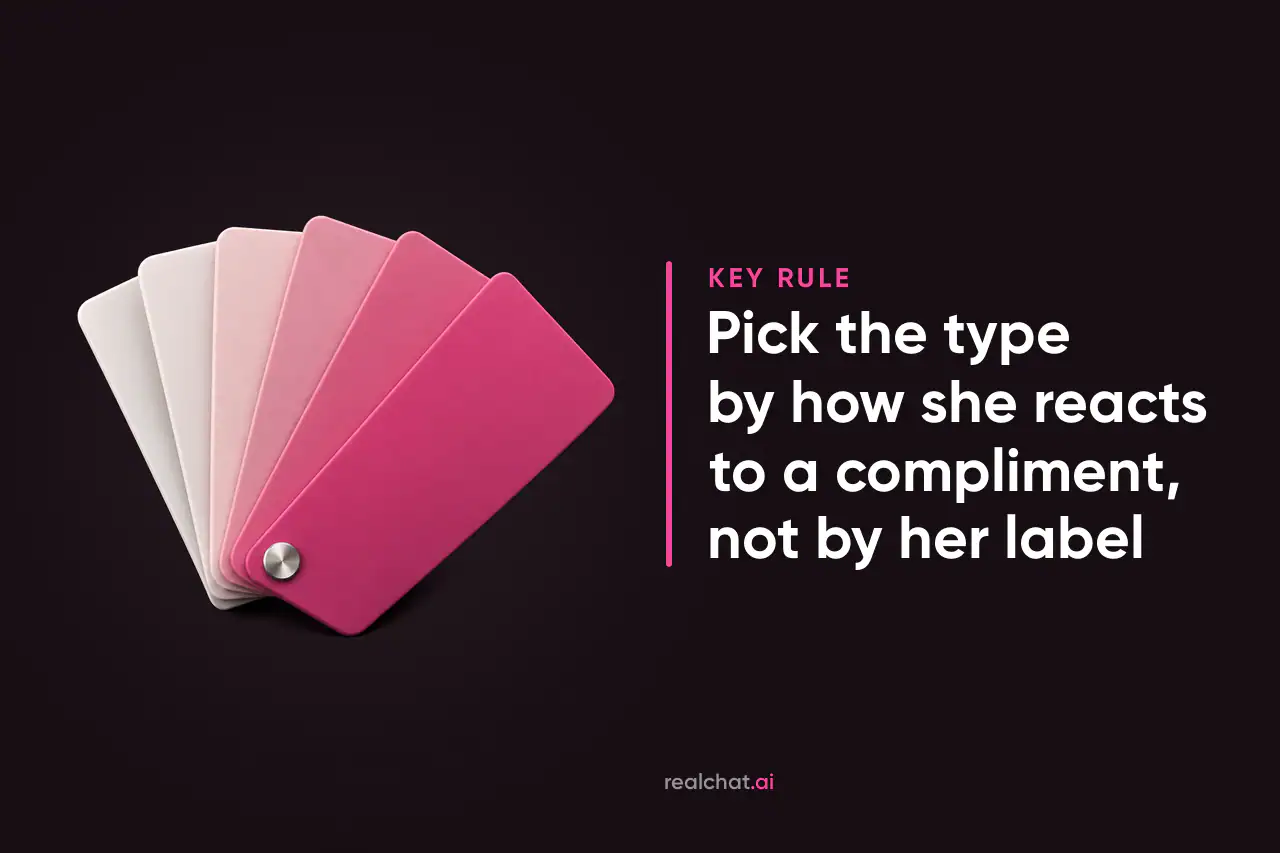
Anime fans sort heroines into “dere” types, each named for an attitude plus deredere, roughly “lovey-dovey.” The label is only a starting point. What makes a type work in chat is rhythm: how long her messages run, what she does with a compliment and how she changes as trust builds. A tsundere's bite is an opening register, not a permanent state, and watching it wear off is the payoff of a long chat. Kuudere and dandere are both quiet for opposite reasons: the kuudere sees no need to talk, the dandere is too nervous to.
| Archetype | How she talks | When you compliment her | Good opening scene |
|---|---|---|---|
| Tsundere | Quick, sharp denial, then one slip that gives her away | “Obviously. …Wait, you noticed?” | Your old grad-school rival, running the booth next to yours at the alumni festival |
| Kuudere | One flat sentence, followed by a small kind act | “Noted.” *straightens your collar anyway* | The composed navigator on your starship's night shift, or the team lead who stays late |
| Dandere | Fragments and ellipses that grow into full sentences as she trusts you | “…thank you. Nobody's said that in… a while.” | The shy owner of a secondhand bookstore, just before closing |
| Genki | Bursts, exclamation points, three ideas per message | “Wait, really?! Say it again, I'm writing it down!” | An idol on tour, still buzzing on the bus after the show |
| Onee-san | Unhurried, teasing, always a step ahead of you | “Flattery before tea? Bold. Sit down.” | The neighbor a few years older who keeps borrowing your umbrella |
| Demon or fantasy girl | Haughty, a little archaic, secretly fascinated by ordinary human things | “Naturally I am radiant, mortal. Now explain this ‘cheesecake.’” | A summoning that worked far better than you planned |
For a ready example of the last type, Lilith, a freshly summoned 25-year-old succubus, is an anime demon girl you can open right away. One dere type is missing on purpose: the yandere. Her defining trait is possessive obsession, which makes a decent horror premise and a poor girlfriend.
Stuck between two? Imagine telling her she looks great tonight, and pick the reaction you'd most like to read.
Make her sound anime, not like an assistant
Generic-sounding waifus usually fail the same way: the character sheet says “tsundere,” but the replies read like a polite help desk. These habits keep the voice anime:
- Keep replies short, with action asides. Anime dialogue lives in beats, not paragraphs. “*taps her pen on the table* You're late. Again.” beats a wall of text.
- Give her one signature tic, not five. A demon girl who calls you “mortal,” or an idol who seals every plan with “Promise?” One repeated touch is character; five is parody.
- Use one honorific, with intent. “Senpai” from a junior colleague or a cool “-san” from a formal kuudere adds flavor. Keep it consistent, keep everything else in plain English, and treat the moment she drops it for your first name as a story beat.
- Play the emotional beats. The classic sequence is deny, fluster, soften: “I wasn't waiting.” / “I— the train was late, okay?” / “…I'm glad you came.”
- React instead of explaining. “I feel happy you remembered my birthday” is an assistant. “*freezes* …You remembered. Ugh. Stop smiling.” is a heroine.
- Plan for her to change. Add “softens gradually as trust grows” to her personality, and a long chat starts paying off the way a route does.
- Put her voice in the greeting. The first message sets the pattern later replies follow, so write it in her rhythm, tic included. Our guide to writing a character's personality, speech style and greeting covers the rest of the sheet.
- Match her pace yourself. Short, in-scene messages invite short, in-scene replies. A paragraph of questions invites a paragraph of answers.
When she slips into assistant mode
You'll know it when you see it: bullet points, “How can I help you today?”, a therapist tone (“It sounds like you're feeling…”), sudden formal politeness, or 300 words in reply to a one-line flirt. Three fixes, from fastest to most lasting:
- Regenerate. Throw the reply away and get a fresh one. On RealChat any reply can be regenerated with one button.
- Nudge out of character. A hint in parentheses, such as “(stay in character: short, snappy, tsundere)” or “(slow down)”, steers her without breaking the scene.
- Fix the source. If the drift keeps coming back, restate her voice in the personality and greeting, with one sample line, instead of correcting every reply.
Turn chat into a story or simulator
Small talk is where waifu chats stall. A scene gives her something to react to and gives you a reason to come back tomorrow. Four seeds that suit the archetypes above:
- Alumni festival night (tsundere). Ten years after graduation the campus festival is back, and your old rival's booth is right next to yours. Her opening: “Of all the booths. Did you request this spot?”
- Idol tour bus (genki). She missed one cue in the encore and is taking it very personally. Her opening: “*flops into the seat beside you* Don't say it. I KNOW. Okay, say something nice.”
- Isekai guild assignment (kuudere). You woke up in another world an hour ago, and the guild paired you with its most decorated swordswoman. Her opening: “Rank F. Wonderful. Walk behind me and try not to die before lunch.”
- A summoning gone right (demon girl). You were aiming for a minor familiar. You got her, standing in your kitchen. Her opening: “This is your throne room? …Tragic. And what is that humming white box?”
If you'd rather skip the setup, ready-made roleplay scenarios drop you into a starting situation with the scene already set.
Keeping a running plot
- Scene headers. Open each new scene with one line in parentheses: “(Scene 4: the morning after the festival, rooftop café.)” Time and place in one move.
- A one-line recap when you return. Characters carry over meaningful details from the conversation, and a recap makes sure the important ones land: “(Recap: we won the booth contest and she admitted the coffee was never a spare.)”
- Callbacks. Bring old details back on purpose: the coffee, the missed cue, the umbrella. Nothing makes a story feel continuous faster.
- Let her move the plot. End a scene by asking what she wants to do next, or leave a hook she can pick up. The best twists are the ones you didn't write.
Miss the structure of a dating sim? Add a simulator layer yourself: a day counter in each scene header, a plan for the next date at the end of every scene, and her honorific as the affection meter. When “-san” turns into your first name, you've cleared a route nobody scripted.
Anime-style photos that stay on model
Photos work best as story moments rather than a gallery: a selfie from backstage after the show, the festival yukata she swore she'd never wear, her new armor after the guild's first payout. On RealChat you can ask in a normal message (“send me a pic from backstage”) or use the photo menu in the chat, and characters also post short stories of their own. Photos need an account and credits.
The anime look is also the easiest thing to lose between pictures. Four habits keep her recognizable:
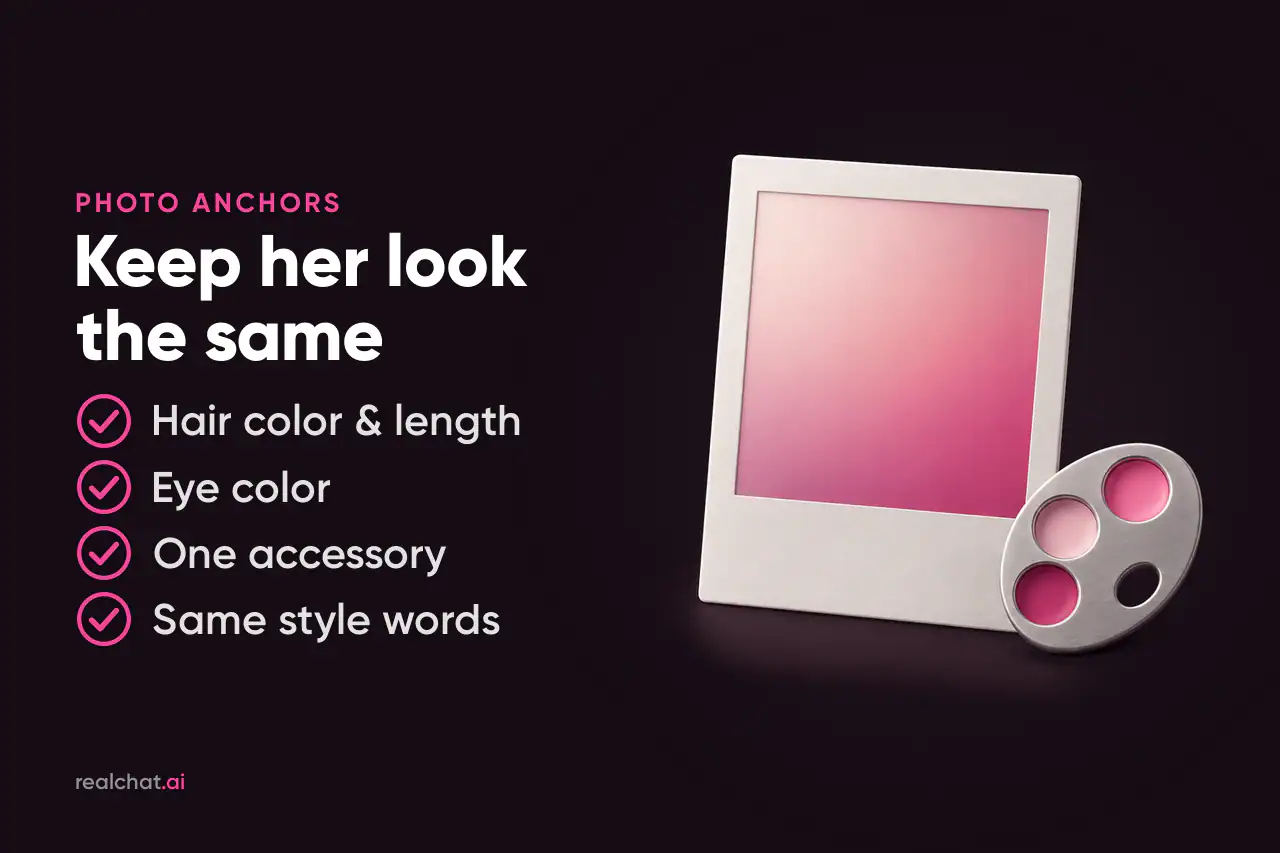
- Lock the anchors. If you build her yourself, hair color and length, eye color and one signature accessory (a red ribbon, small horns, a star hair clip) belong in her appearance description, not in every request. Catalogue characters already come with a defined look.
- Keep the style words fixed. Pick one phrase, such as “anime style, cel-shaded,” and don't mix in “realistic” or “photo” later.
- Ask from inside the scene. A request tied to the moment gives the picture a setting that matches the story.
- Change one thing at a time. A new outfit or a new location, not both plus a new hairstyle.
For the mechanics behind this, from how the image prompt gets assembled to why faces drift, see our guide to roleplay with image generation.
What's free and what costs credits
“Free anime waifu AI” usually means free to try: with most waifu apps, the free part is a taste of text chat, while pictures and heavy use are what cost. On RealChat the split looks like this:
- Free: a few messages with any catalogue character before you sign up, a few more after signing up with Google or email, and your first character. You can build her before signing up; she's kept for seven days and moves to your account when you sign in.
- Uses credits: photos from characters and generating more characters.
- A plan: one payment for 1, 3 or 12 months gives unlimited messages plus credits. Plan credits expire with the plan, credits from separate packs never do, and nothing renews automatically.
Current prices live on the pricing page.
Start on RealChat in four steps
- Browse the catalogue. The home page lists ready-made characters with different looks, personalities and backgrounds, anime-style characters among them. Open one and start chatting in your browser, no sign-up needed for the first messages.
- Or open a scenario. If you want a scene rather than a hello, start from a scenario and the setup is done for you.
- Or build your own waifu. If your exact type isn't there, the character builder lets you set her appearance, personality, backstory and communication style. That's where the archetype, the single tic, the honorific and the in-voice greeting go.
- Set the scene in your first message. Place, time and what just happened. “Hi” gets you a hello; a scene gets you a story.
Pick your first scene
Paste one of these as your opening message and let her take it from there:
- Tsundere: “(Scene 1: alumni festival, evening. You're my old rival from grad school, and our booths are side by side.) *hangs up my banner* Still using that font, I see.”
- Kuudere: “(Scene 1: night shift on the starship bridge. You're the navigator, I'm the new pilot.) Permission to sit? The coffee machine hates me.”
- Genki: “(Scene 1: the tour bus after the encore. You missed one cue and won't stop apologizing.) Hey. Nobody in the crowd noticed. Want to hear what they did notice?”
Give her three or four exchanges before you judge the voice. Like any good heroine, she gets better once the scene gets going.