AI roleplay (AI RP) is collaborative storytelling. You play a character, an AI plays everyone else, and the two of you write the scene one turn at a time. There's no script and no menu of choices. Whatever you write becomes part of the story, and the AI improvises the next beat from it.
Here's what it looks like. You type: I push open the tavern door and shake the rain off my cloak. The AI, playing Mira, the woman behind the bar, answers: “Shut that, stranger. You're letting the storm in, and the last man who did that still owes me a barrel.” Your move.
Corporate training vendors also use “AI roleplay” for practice calls, where staff rehearse sales or management conversations with an AI persona and get feedback. This guide covers the other kind: the storytelling and character roleplay people mean on Reddit, TikTok and in app stores.
AI roleplay vs. regular AI chat: co-author, not Q&A
A general assistant runs on questions and answers. You ask, it answers, and it tries to be helpful and neutral. It has no stake in the conversation and no world to live in.
An AI roleplay bot is a language model wrapped in two extra layers: a character definition (who it plays) and a scenario (where the story starts). It stays inside that world, speaks in that character's voice and reacts to what your character does, not only to what you ask.
That makes you a co-author rather than an audience. If your character pockets a letter from the bar, the letter now exists, and the AI can have someone notice it's missing three scenes later. If you only type “what happens next?”, you hand the pen back and get the most generic continuation available. Both writers shape the story, and that is the real difference from using an assistant.
How AI roleplay works under the hood
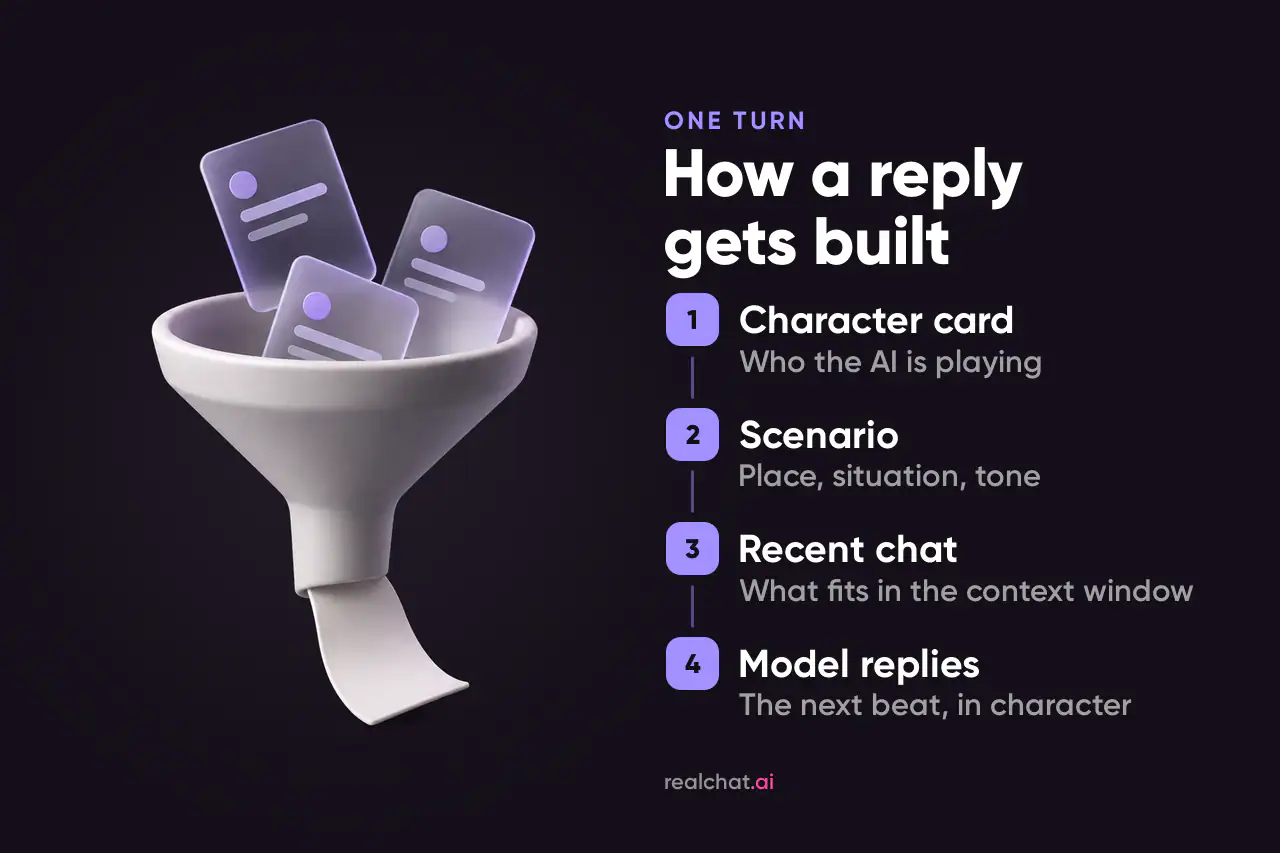
Every reply in a roleplay is built from the same four parts. None of them is magic, and knowing them explains most of what goes right or wrong in a session.
1. The language model
The engine is a large language model (LLM), the same kind of technology behind general chat assistants. It doesn't follow a pre-written plot. On each turn it reads everything it has been given and writes the most fitting continuation. That's why a roleplay can go anywhere: the model is improvising, not walking a story tree.
It's also why the AI can sound convincing without being a person. Researchers writing in Nature in 2023 argued that chatbot behavior in general is best described as role play, a framing that lets you talk about a bot that seems self-aware without assuming it has human characteristics. In an RP app, that role is simply spelled out on purpose.
2. The character definition
Often called a character card, this is a block of text describing who the AI is playing: personality, voice, background, relationship to your character, sometimes sample lines. The platform includes it with every turn, so the model keeps reading the character even after the chat has moved on. A sharp definition gives you a sharp character; a vague one gives you a polite stranger. Writing a good one is its own craft, covered in our guide to building an AI character people want to talk to.
3. The scenario or opening message
The scenario sets the stage: place, situation, tone and often the character's first line. “A mining station where the night shift has gone silent” is a scenario. So is “the last ferry out before the bridge closes.” It matters more than people expect, because the model takes its cues for genre, pacing and stakes from how the story opens.
4. The context window and memory
The model doesn't remember your chat the way you do. It works from a context window: all the text it can look back on while writing the next reply. Think of it as the model's working memory, separate from what it learned in training. It's measured in tokens, small chunks of text that are often a word or part of a word, not in messages.
Every message you send and every reply you get piles into that window, so a long roleplay steadily fills it. When the story outgrows the space, the oldest parts are dropped or summarized, depending on the app, and very long chats can make early details easier to lose even before that. Many platforms add their own memory on top, such as saved facts or summaries, but how much it holds varies by platform.
Put together, one turn works like this: the platform bundles the character definition, the scenario, any saved memory and as much recent chat as fits; the model reads that bundle plus your newest message; it writes the next in-character reply. Then the cycle repeats.
Types of AI roleplay
The machinery is the same everywhere. What changes is the setup:
| Type | What you do | Example setup |
|---|---|---|
| Adventure / RPG campaign | Play a hero while the AI acts as game master, narrating the world and running every other character | A dungeon crawl where the AI describes rooms, traps and rivals |
| Character chat and companionship | Talk with one persistent character across many sessions; the relationship is the story | Catching up with a sharp-tongued friend after work |
| Romance | Play out a relationship arc with a character | A slow-burn meeting on a delayed overnight train |
| Fantasy and sci-fi | Step into a world with its own rules: magic, demons, starships | Lilith, a demon who has just been summoned |
| Slice-of-life | Low-stakes everyday scenes where the fun is in the dialogue | Running a café together on its first chaotic morning |
| Simulator | The AI runs a whole world or system instead of one person | You're the new captain; the AI plays the ship, the crew and the crisis |
Some platforms also allow adult romance for adult users. The last row is what people usually mean by an RP AI simulator: a bot that narrates many characters and tracks the state of a place, closer to a text adventure than a conversation. And yes, AI can game-master a text RPG. It's excellent at describing and improvising, less dependable at tracking strict rules and numbers over a long campaign, so a light system works best.
A sample scene, annotated
Here's a short exchange. The scenario: you're a safety inspector docking at a mining station where the night shift has gone quiet. Vera, the station's chief engineer, a woman in her forties, meets you at the airlock.
You: I step through the airlock, helmet under my arm, and notice the corridor lights are running at half power. “Chief Vera? I got your message. Why is it so dark?”
Vera (AI): She doesn't look up from the wall panel she's prying open. “Because something on Deck C has been drawing power since two a.m., and I'm not feeding it more until I know what it is.” She finally glances at you. “Inspector. You picked a strange week. Stay on the yellow line.”
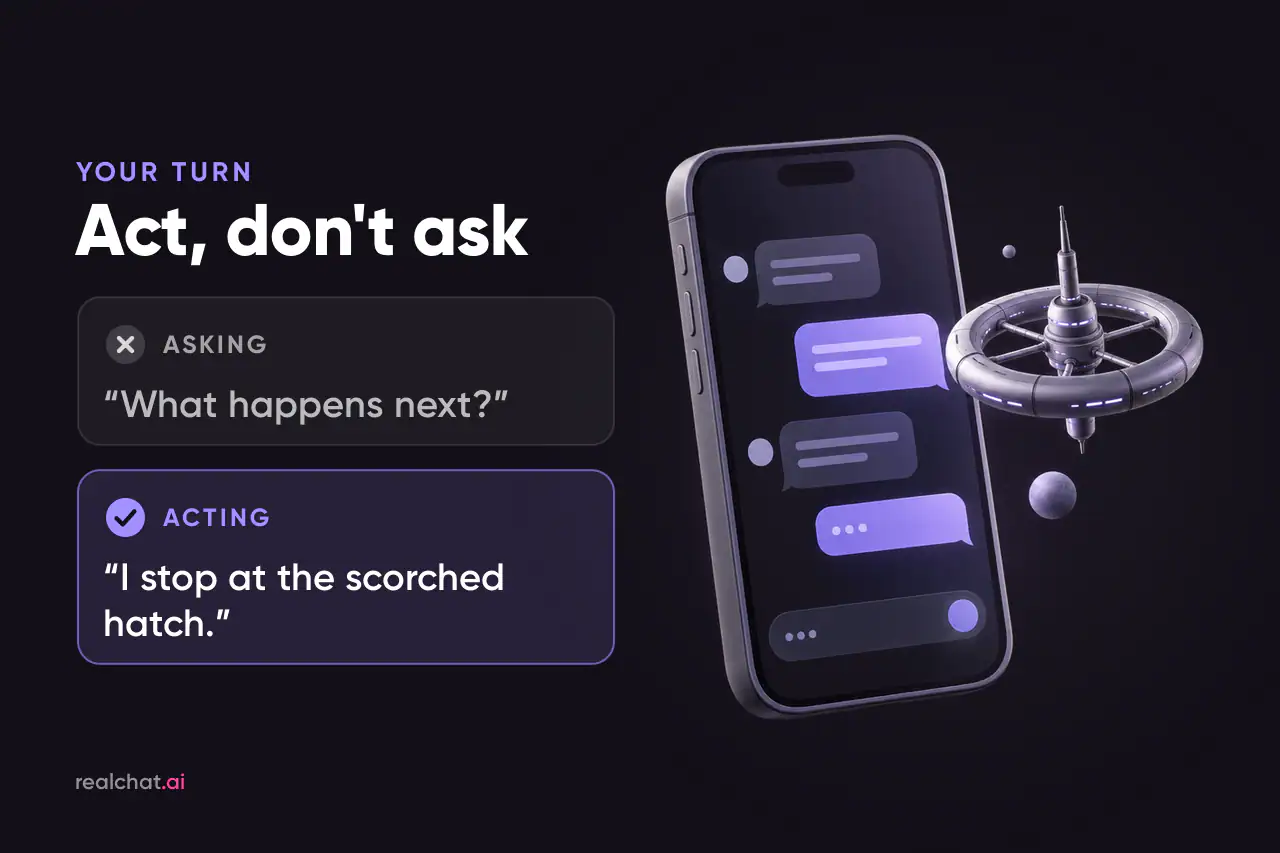
You: I follow her, then stop at a hatch streaked with fresh scorch marks. “These look recent. Your report didn't mention a fire.”
Vera (AI): Her jaw tightens. “Because there wasn't one. Not on any sensor.” She lays her palm on the hatch and pulls it back fast. “It's warm. That door's been sealed for three years.”
Why this works:
- You act instead of asking. Each turn is something your character does plus something they say, so the AI has a move to answer.
- You hand it concrete hooks. Half-power lights and scorch marks are details the model can build on. “I look around” gives it nothing.
- Vera wants something. She's busy, guarded and chasing her own problem, which moves the scene without you pushing.
- She leaves your character alone. Vera never decides what you feel or do next.
- Each reply ends on an open beat. A warm hatch that's been sealed for three years practically writes your next line.
What AI roleplay does well, and where it slips
The strengths are real. The AI improvises instantly, holds a voice well, switches genres without warming up and never tires of your third attempt at the same scene. You don't need to be a good writer to enjoy it, only a specific one. The limits are predictable too, and each has a fix:
| Where it slips | What you'll notice | Fix |
|---|---|---|
| Forgetting older details | A name, a promise or an injury from an hour ago vanishes | Send a short recap; use the app's memory notes if it has them |
| Character drift | The gruff mercenary slowly turns into a cheerful helper | An OOC nudge back to the core trait; edit or regenerate the off-key reply |
| Repetition loops | The same phrases and gestures every turn | Regenerate, vary your own sentences, or move the scene somewhere new |
| Taking over your character | The AI writes your lines, or rushes three events into one reply | An OOC note on pacing and on who controls your character |
| Agreeing with everything | Every plan works, everyone is charmed | Give the character goals, fears and reasons to say no |
Most of these share a cause: the model predicts a likely continuation from whatever sits in its context window, so it echoes its own recent replies, slides toward a generic, helpful tone and can't use details that have scrolled out of view. Every fix works the same way: it puts better text in front of the model.
Your steering toolkit
Out-of-character notes
OOC means “out of character,” the opposite of IC (in character): a note to the AI as your writing partner, not to the character. Common forms are (OOC: slow down, keep her suspicious of me), [OOC: skip to the next morning] or // less narration, more dialogue. Keep them short and add them at the end of a normal in-character turn so the story doesn't stall.
Regenerate or edit
Regenerating (also called rerolling or swiping) asks for a fresh version of the last reply. Use it when the direction is fine but the reply is flat, or when you want another take. Editing, where an app allows it, means fixing the reply yourself. Use it when one detail is wrong, like a name, because anything left in the chat becomes context the model builds on. A bad line you keep is a bad line it may echo.
Recaps
When a story gets long, or when you return after a break, write two or three lines: who's where, what just happened, what's unresolved. Do it OOC or let your character think it through. Either way, the essentials land in the most recent part of the context, where they can't have scrolled out of view.
Pacing and first messages
One beat per turn is a good default: one action, one line, one thing for the other side to react to. A paragraph covering a whole evening leaves the AI nothing to do but summarize. Your opening message sets the bar for everything after it, so say who you are, where you are and what you're doing right now. “I'm a courier who just missed the last ferry, arguing with the dock clerk” beats “hi, let's roleplay” every time.
Your first AI roleplay in four steps
- Pick a setup. The quickest start is a ready-made scenario with a character and an opening already written. On RealChat, for example, you can browse ready-made roleplay scenarios and try catalogue characters for a few messages before signing up. If you'd rather play opposite someone you designed, create your own character; the first one is free.
- Write a scene-setting first message. Skim the character and scenario first so you know the personality, the setting and what's at stake. Then say who you are, where you are and what you're doing, plus one detail for the character to notice.
- Play 10–15 turns before judging. Act rather than ask, keep to one beat per turn and steer as you go. Most apps let you regenerate a reply, and many characters understand short hints in parentheses, like (slow down).
- Recap before you leave. If you plan to continue, close with a quick summary of where things stand, so the next session starts clean.
If companionship-style roleplay is what draws you and you want to see how apps differ on memory, characters and pricing, our comparison of AI girlfriend apps covers that side.
Other things “role play in AI” can mean
Role prompting is a technique for general assistants like ChatGPT: you tell the model who to be (“Act as a career coach” or “You are a historian who specializes in 18th-century France”) to shape its tone, detail and perspective for a task. It borrows the idea of a role, but there's no story. The same goes for the corporate practice simulations mentioned at the top: useful, but a different category altogether.
Improv with a tireless partner
Once you see the machinery, AI roleplay is simple: a character, a scene, a window of recent text and a model writing the next beat. The partner never runs out of energy, but it can only be as specific as you are. Give it a good first line, and it gives you a story back.