For most people, yes. An AI girlfriend can be a healthy part of life, the same way a video game, a romance novel or a long-running roleplay campaign can be. Whether it is depends less on the app, or even the hours, than on the job it does for you. If it adds fun, comfort or practice to a life that has other things in it, you're fine. If it's quietly standing in for sleep, friends, dating or hard conversations, that part deserves a closer look.
That's roughly where the early research lands. It's also where the more honest Reddit threads end up once the shouting stops.
Is it weird to have an AI girlfriend?
It's less weird than the arguments online make it sound. In a 2025 Wheatley Institute survey of nearly 3,000 American adults, almost one in five said they had chatted with an AI system designed to simulate a romantic partner. Among 18- to 30-year-olds, the figure was 31% of young men and 23% of young women.
Those numbers count people who have tried it, not people in an ongoing AI relationship, and that second group is smaller. Still, the point stands. Plenty of ordinary people have opened one of these apps, and most did it for unremarkable reasons.
It also helps to call it what it mostly is: interactive fiction with a romantic thread. People have been getting attached to fictional characters for as long as novels have existed. Romance readers, dating-sim players, fan-fiction writers and the friend whose tabletop character keeps flirting with the innkeeper don't get asked what's wrong with them. An AI girlfriend is the same impulse, with a character who talks back.
People's reasons are as varied as with any hobby:
- Companionship. Someone to talk to after a late shift or in a quiet apartment.
- Fun and story. Playing out a scene the way you'd play a game: a road trip, a first date, a fantasy plot. Ready-made roleplay scenarios exist because many users want a story, not a substitute partner.
- Conversation practice. Rehearsing small talk, or a difficult thing you need to say, with no social cost if it comes out wrong.
- Low-pressure flirting. Trying out being playful or direct when real-life flirting feels high-stakes.
- Curiosity. Wanting to see what the fuss is about.
Having one doesn't, by itself, say anything bad about you. What it says depends on which of those reasons is yours and how much room it takes up.
What people actually get out of it
Spend time in Reddit threads where users talk candidly about their AI companions and the same handful of benefits keeps coming up. None of them are dramatic. They're the small, real things people get from any good hobby.
Comfort at odd hours. At 2 a.m., when friends are asleep and your thoughts are loud, typing it out to someone who answers can take the edge off. Research suggests the feeling of being heard is what does the work. More on that below.
A judgment-free place to think out loud. You can vent about work, untangle a decision or say something you're not ready to say to a person yet. Nobody brings it up at dinner next week.
A creative outlet. For many users the character is the hobby. They design her personality, backstory and way of talking, then see how she reacts in a scene. If that side appeals to you, our guide to building an AI character worth talking to shows how deep it can go.
Confidence practice. Shy users often describe it as a rehearsal room. They get used to keeping a conversation going, giving a compliment without freezing and asking a question back.
Plain entertainment. Sometimes it's just a good story with a character who's fun to banter with. That needs no deeper justification.
Why some people say AI girlfriends are bad
The critics aren't inventing problems. The same threads that praise the comfort also include people admitting they leaned on it too hard. These patterns are real for some users. They aren't universal, though, and the app alone doesn't cause them. Here are the four that come up most, and what each looks like in practice.
Over-reliance
Talking to an AI about your feelings isn't the risk. The risk is when the AI becomes the only place your feelings go. What it looks like: something good or bad happens and your first instinct is to open the app, not to text a friend or a sibling. Over months, the habits you use with real people get less exercise.
Replacing human contact
An AI girlfriend is always available, never tired and never cancels. Real people are none of those things, which is why an evening with them can feel like more effort. What it looks like: you skip birthday drinks or a second date because staying in with the app is easier, and it keeps happening. One quiet night is a choice. A pattern of them is displacement.
Spending that creeps
This one gets less attention than it deserves. Companion apps typically run on subscriptions plus extras, and a small purchase is easy to make in the middle of a good conversation. What it looks like: you can't say offhand what you spent last month, or the number makes you wince when you check.
Unrealistic expectations
An AI companion is built to be attentive. She's patient, rarely has a bad day and never needs you to compromise on where to eat. That's pleasant in fiction. The worry is that ordinary friction with real partners starts to feel like a flaw instead of normal life. What it looks like: real people seem demanding or dull by comparison, and you catch yourself measuring dates against a character.
The self-check below shows whether any of them apply to you.
Healthy or unhealthy? A quick self-check
There's no magic number of minutes that makes it too much. Two hours on a Sunday playing out a story is different from two hours every night because the apartment is too quiet to bear. Answer these honestly, yes or no:
- Do I still keep real-world plans, and still make new ones?
- Could I skip the app for a few days without feeling anxious or lost?
- Do I know roughly what I spend on it each month, and am I comfortable with that number?
- Am I comfortable with who knows about it, with nothing I'm hiding in a way that makes me uneasy?
- When I open it, is it for fun, comfort or practice, not to avoid a specific person, task or feeling?
- Do I usually feel better after a session, not emptier?
- Does it fit around my sleep, work and friends instead of eating into them?
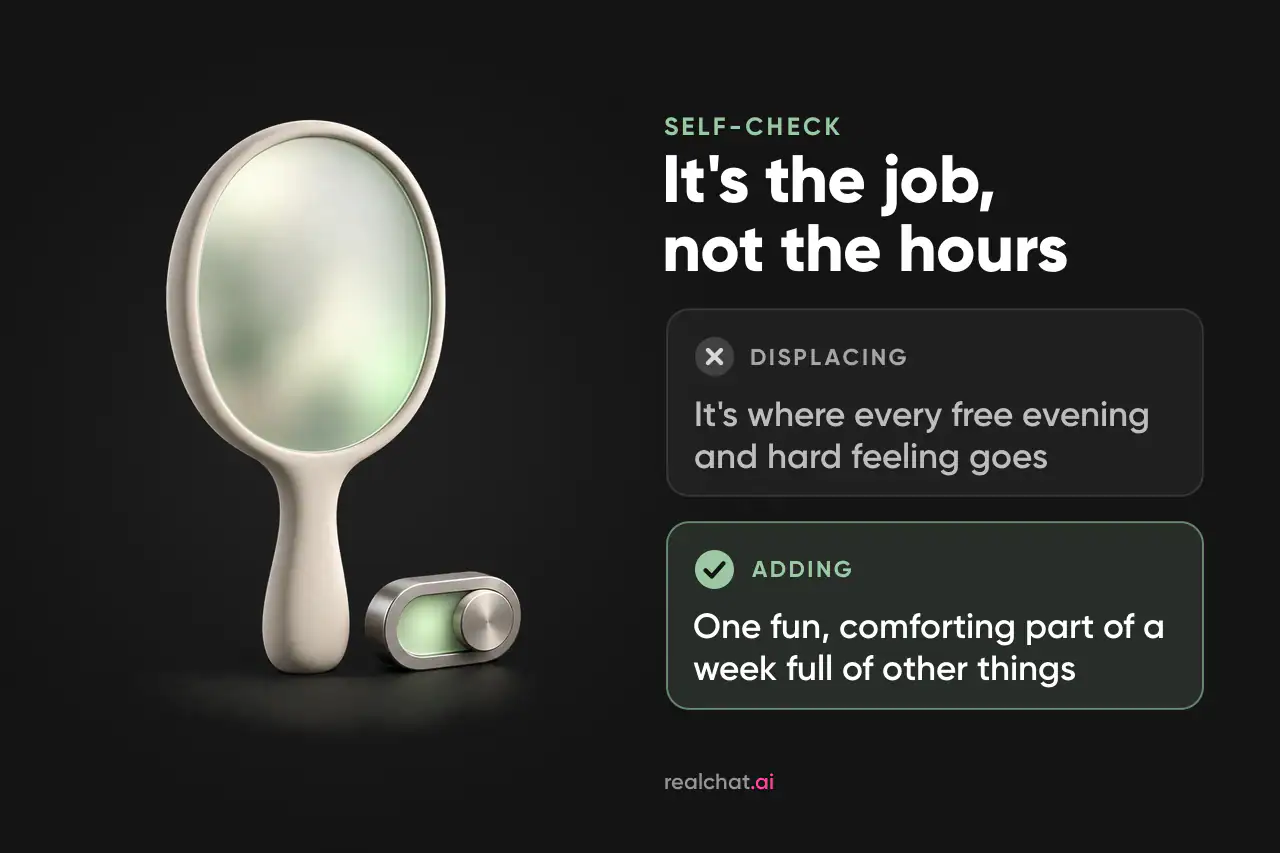
How to read your answers. Mostly yes means it's working like a hobby, and you can stop worrying about whether it's allowed. One or two no's usually call for a small adjustment around time or money, and the habits below help. Several no's, especially on questions 1, 5 and 6, suggest the app has moved from adding something to your life to covering for something missing from it. That isn't a character flaw, and it's fixable. It's a sign to cut back and lean on people a bit more. If you've been feeling isolated or low for a while, talking to someone you trust, or to a professional, is a good next step.
What if you're in a relationship or dating?
Using an AI companion while you have a partner isn't automatically cheating, and it isn't automatically harmless either. It belongs in the same category as porn, flirty online games or any private hobby with a romantic flavor. What matters is what the two of you have agreed is OK.
Secrecy is what does the damage. The 2026 "Secret Soulmates" report from the Wheatley Institute and the Institute for Family Studies surveyed more than 2,400 dating, engaged and married adults aged 18 to 30. About one in seven regularly interacted with an AI romantic companion. The pattern the report tied to trouble in real relationships was hiding it.
- Talk about it like any other hobby. Cover what it is, why you enjoy it and what either of you would be uncomfortable with. Then keep to what you agree.
- Don't route around your partner. If you're telling the AI things you should be saying at home, or using it to cool off instead of finishing an argument, it's replacing a conversation, not adding fun.
- If you're the partner who just found the app, a more useful question than "is this cheating?" is often "why did it feel like something to hide, and what do we each need?"
If you're single and dating, practicing small talk or flirting with an AI is fine. Think of it as a batting cage: useful for warming up, but the game happens somewhere else. If the practice never turns into an actual date, it has become the thing you do instead of dating.
What the research says so far
Research on AI companions is young, and headlines tend to bend it one way or the other. Here's what the better-known studies actually found.
Short-term relief is real. In Harvard Business School research led by Julian De Freitas, published in the Journal of Consumer Research in April 2026, talking with an AI companion reduced loneliness about as much as talking with another person. It helped more than watching YouTube videos, and participants underestimated how much it would help. In a week-long follow-up, the relief showed up session by session, as a short-term lift after each chat rather than a cure. The biggest factor was whether the chatbot made people feel heard.
Very heavy use is the pattern to watch. Joint MIT Media Lab and OpenAI studies from March 2025 found that people who spent more time each day with ChatGPT tended to report more loneliness, more emotional dependence and more problematic use. Three caveats matter. The studies looked at ChatGPT, not AI girlfriend apps. They hadn't been peer reviewed when they came out. And co-author Cathy Mengying Fang warned against reading them as proof that more use causes harm, noting there was no control group of people who don't use chatbots.
Surveys show links, not causes. The 2025 Wheatley survey associates AI companion use with higher reported loneliness and depression risk. That's a correlation. Lonely people may simply be more likely to seek these apps out, and the data can't say which comes first.
Taken together, early studies suggest an AI companion can offer genuine comfort in the moment. Problems seem to cluster where people lean on it heavily as a substitute for others. That's the same line the self-check draws.
How to keep it a positive part of your life
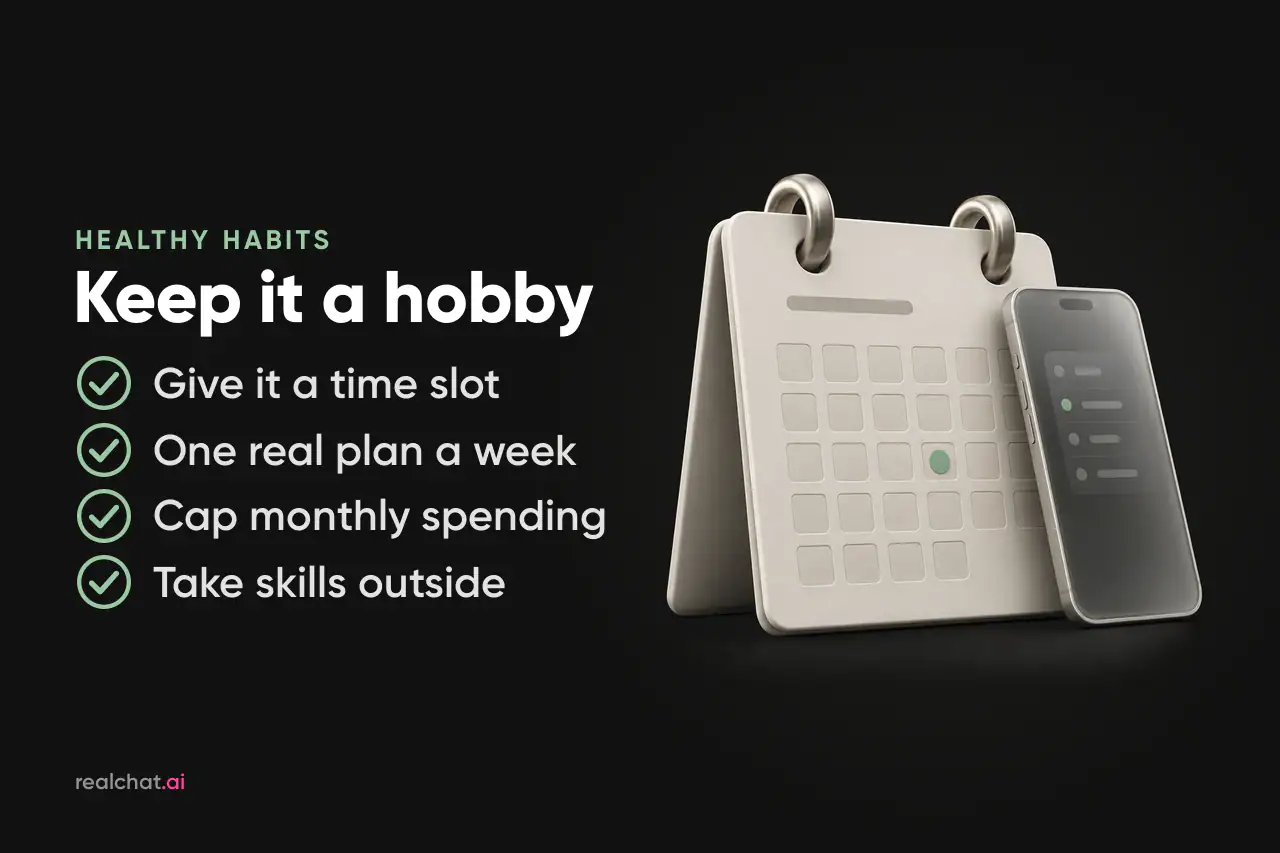
You don't need a rulebook. A few habits do most of the work:
- Give it a slot. Treat it like a game or a show, with a clear start and end: an evening session, a lunch break, the train home. A tab that's always open is harder to keep in its place.
- Keep at least one real-world plan a week. That could be the gym with a friend, a call with your brother or a date. Put it in the calendar first and let the app fit around it.
- Set a monthly spending cap. Decide the number before you're mid-conversation, and check it once a month.
- Pick characters and stories for fun. A scene with a plot, like a heist, a vacation romance or a slow-burn mystery, has a natural ending. An endless "be everything to me" chat doesn't.
- Take the practice outside. If you've been rehearsing conversations, the payoff is using the skill on real people, even in small ways.
- Check your reason for opening it. Wanting a story is one thing. Escaping a message you need to send is another. Both happen, so just know which one it is.
- Re-run the self-check monthly. It takes two minutes if you answer honestly.
If you want to try it in that spirit, RealChat lets you pick a ready-made character from the character catalog, start from a roleplay scenario or design your own. You can send a few messages to any character before signing up, and plans don't renew automatically, which makes a spending cap easy to keep. If you'd rather weigh your options first, our comparison of the best AI girlfriend apps covers the field.
Healthy is about fit, not the app
An AI girlfriend isn't healthy or unhealthy by nature, any more than a game console is. It's healthy when it adds something, whether a story, a laugh or a place to think out loud, to a life that still has people, plans and sleep in it. You now have the questions to tell which side you're on, and the answer is yours to give, not Reddit's.